The Aoki Lab
Arithmetic Module Generator (www.aoki.ecei.tohoku.ac.jp/arith/mg/), rebuilt from the Internet Archive.
Reborn in 2026: the request forms answer again, right here in your browser, with generic Verilog and a testbench. No mail, no queue.
About the rebirth
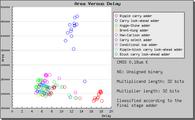
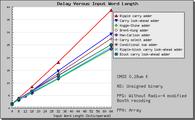
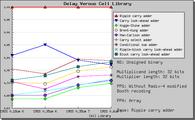
The following figures illustrate the performance comparison of multipliers generated by the Arithmetic Module Generator.
Each multiplier has been synthesized by Synopsys Design Compiler using several standard cell libraries.
As a result, the obtained data is useful especially for standard cell-based design.
-
[1] : Comparison of different multiplication algorithms.
-
[2] : Comparison of different input word-lengths.
-
[3] : Comparison of different cell libraries.
|
|
|
| Example of [1] |
Example of [2] |
Example of [3] |
The compile option is "-only_design_rule" for evaluating the hardware
algorithm properly. The delay and area information is calculated
according to the non-linear model given in the target cell library.
Information on the power consumption is estimated by Synopsys Power
Compiler, assuming that the switching activity is 1 GHz, and the
toggle rate is 0.5. These calculations are performed without any
place-and-route information.
The standard cell libraries considered here are as follows:
- CMOS 0.18um K: Hitachi 0.18um standard cell library from Kyoto University [1],
- CMOS 0.25um: TSMC 0.25um standard cell library [2][3],
- CMOS 0.35um K: Rohm 0.35um standard cell library from Kyoto University (low-power version) [1],
- CMOS 0.35um T: Rohm 0.35um standard cell library from University of Tokyo,
- CMOS 0.6um T: Rohm 0.6um standard cell library from University of Tokyo.
Note here that there is no valid comparison between two target cell libraries in Figure 3.
Information on these cell libraries is obtained from VDEC
website and [1-3].
-
M. Hashimoto, K. Fujimori, and H. Onodera, .Standard cell libraries
with various driving strength cells for 0.13, 0.18, and 0.35 um technologies,
. Proc. of Asia and South Pacific Design Automation Conference
2003, pp. 589 . 590, Jan. 2003.
- J. B. Sulistyo, J. Perry, and D. S. Ha, "Developing Standard Cells for TSMC
0.25um Technology under MOSIS DEEP Rules", Department of Electrical and
Computer Engineering, Virginia Tech, Technical Report VISC-2003-01, November
2003.
-
Jos. B. Sulistyo and Dong S. Ha, "A New Characterization Method for Delay and
Power Dissipation of Standard Library Cells", VLSI Design 15 (3), pp. 667-678,
2002.
Back to Arithmetic Module Generator home