A Fable 5.1 / Opus 5.5 experiment, run for one month, to implement different instruction set architectures. ARM, SPARC and RISC-V were generated almost instantly. X86 was a bit harder. The rest of the month was spent on continuous debugging boot of Windows 98. Hammering out the difficult cases took Fable running in agent mode for days.
Download l8cpu-dist.tar.gz, unpack it and start the menu:
tar xzf l8cpu-dist.tar.gz
cd l8cpu
make
make asks a few questions (below), checks the programs
your machine needs and says how to install what is missing, downloads
what has to be downloaded, programs the board and starts the console.
make help lists the single steps.
The Verilog of every system is in this archive: generated from the
high-level description, one file per system, without comments. Each
top.v is the whole system as Verilator simulates it -- the
processor, its caches, its memory and its peripherals -- and
tb.cpp beside it is the C++ testbench that drives it.
| system | Verilog | top module | testbench |
|---|---|---|---|
| x86, Linux | verilator/x86/top.v |
x86_pc_linux_top |
verilator/x86/tb.cpp |
| x86, Windows 98 | verilator/win98/top.v |
x86_pc_win98_top_hb |
verilator/win98/tb.cpp |
| SPARC V8, Linux | verilator/sparc/top.v |
top |
verilator/sparc/tb.cpp |
| ARMv8-A (A32), Linux | verilator/arm/top.v |
top |
verilator/arm/tb.cpp |
| Cortex-M3, FreeRTOS | verilator/m3/top.v |
top |
verilator/m3/tb.cpp |
| serv (RISC-V), FreeRTOS | verilator/serv/top.v |
top |
verilator/serv/tb.cpp |
Processors written in a high-level hardware description language, running real operating systems on a Digilent Arty A7-100T FPGA board -- or simulated on your PC with Verilator:
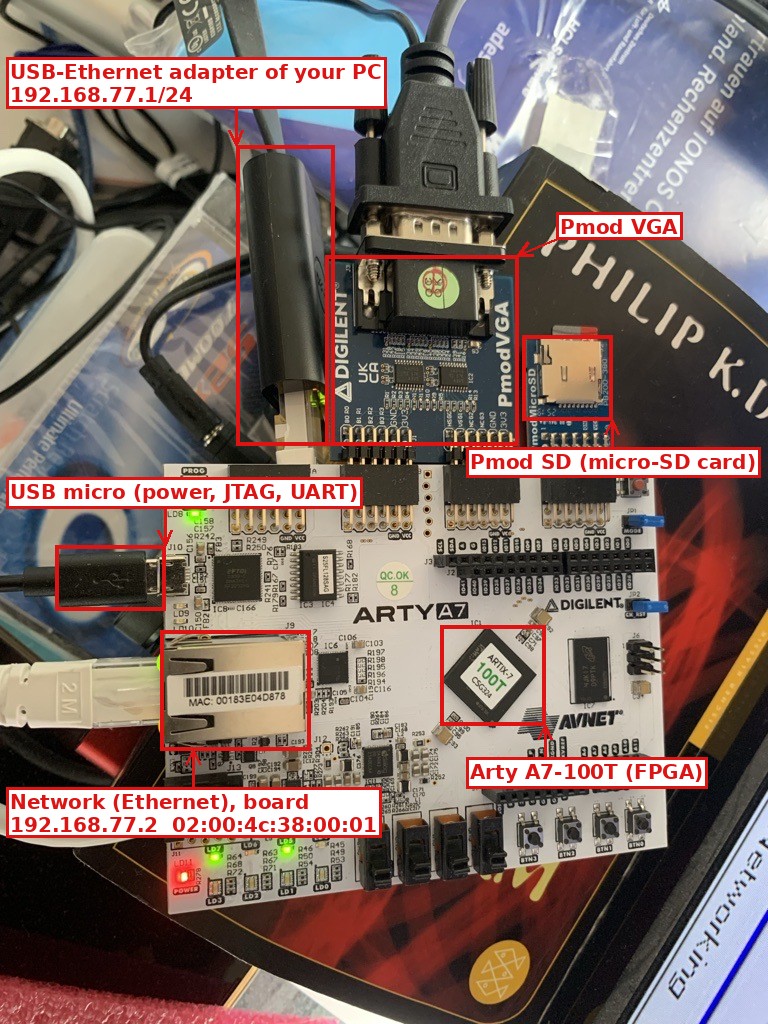
What you see on the board:
| Arty A7-100T | the FPGA board (Xilinx Artix-7 100T) that carries the processor and its peripherals |
| Pmod SD | a Digilent Pmod MicroSD with a micro-SD card: the Windows 98 hard disk |
| Pmod VGA | a Digilent Pmod VGA: the PC's screen on a real monitor (optional -- the screen is also shown on your PC) |
| USB micro | the board's USB port: power, programming (JTAG) and the serial console |
| Network (Ethernet) | the board's Ethernet port: the console, the debugger and the disk link to your PC. Address 192.168.77.2, MAC 02:00:4c:38:00:01 |
| USB-Ethernet adapter | the adapter on your PC (top left, beside the Pmod VGA); its cable runs under the board to the board's Ethernet port. Address 192.168.77.1/24 |
The menu asks one question after the other; each answer can also be given on the command line.
| question | choices | on the command line |
|---|---|---|
| 1. Where should the system run? | arty -- the Arty A7-100T board, or
verilator -- simulated on this PC |
TARGET=arty / TARGET=verilator |
| 2. Which processor? | x86, arm, sparc,
serv, m3 |
CPU=... |
| 3. Which system on the x86? (x86 only) | linux -- Linux 6.12, or win98 -- Windows
98 |
OS=linux / OS=win98 |
| 4. A microSD Pmod on the Arty's JD connector? (Windows 98 on the Arty) | yes -- the disk is the card, no -- the
disk is a file on this PC, served over Ethernet |
SD=yes / SD=no |
| 5. Write the Windows 98 image onto the card first? (with SD) | yes -- a first run, ~15 min, sync -- bring
the card back to the image, ~3 min, no -- the card as it
is |
WRITE=yes / WRITE=sync /
WRITE=no |
| 6. Networking through SLIRP on this PC? (Windows 98 on the Arty) | slirp -- the dial-up provider on the PC's modem port,
no |
NET=slirp |
Every combination, started directly:
| what | command |
|---|---|
| Windows 98 on the Arty, disk on the SD card, with dial-up internet | make TARGET=arty CPU=x86 OS=win98 SD=yes WRITE=sync NET=slirp |
| Windows 98 on the Arty, disk on this PC (no SD Pmod; an older bitstream: dial-up is reliable only with the SD card) | make TARGET=arty CPU=x86 OS=win98 SD=no |
| Linux on the x86 | make TARGET=arty CPU=x86 OS=linux |
| Linux on the ARMv8-A | make TARGET=arty CPU=arm |
| Linux on the SPARC V8 | make TARGET=arty CPU=sparc |
| FreeRTOS on serv (RISC-V) | make TARGET=arty CPU=serv |
| FreeRTOS on the Cortex-M3 | make TARGET=arty CPU=m3 |
| any of them simulated | the same with TARGET=verilator (for the x86:
OS=linux or OS=win98) |
The Windows 98 disk image is copy.sh's (taken from
images/ when present, downloaded otherwise) and patched on
your machine (see the note below); it comes up with a modem on COM2 and
a Dial-Up Networking connection already set up.
TIP -- OPEN THINGS WITH ONE CLICK AND ENTER, NOT A DOUBLE CLICK. On the Arty a double click is often not recognised. Click an icon once to select it, then press Enter to open it.
Start it with NET=slirp, then in Windows:
rundll32 rnaui.dll,RnaDial My Connection;ping www.example.com in an MS-DOS Prompt.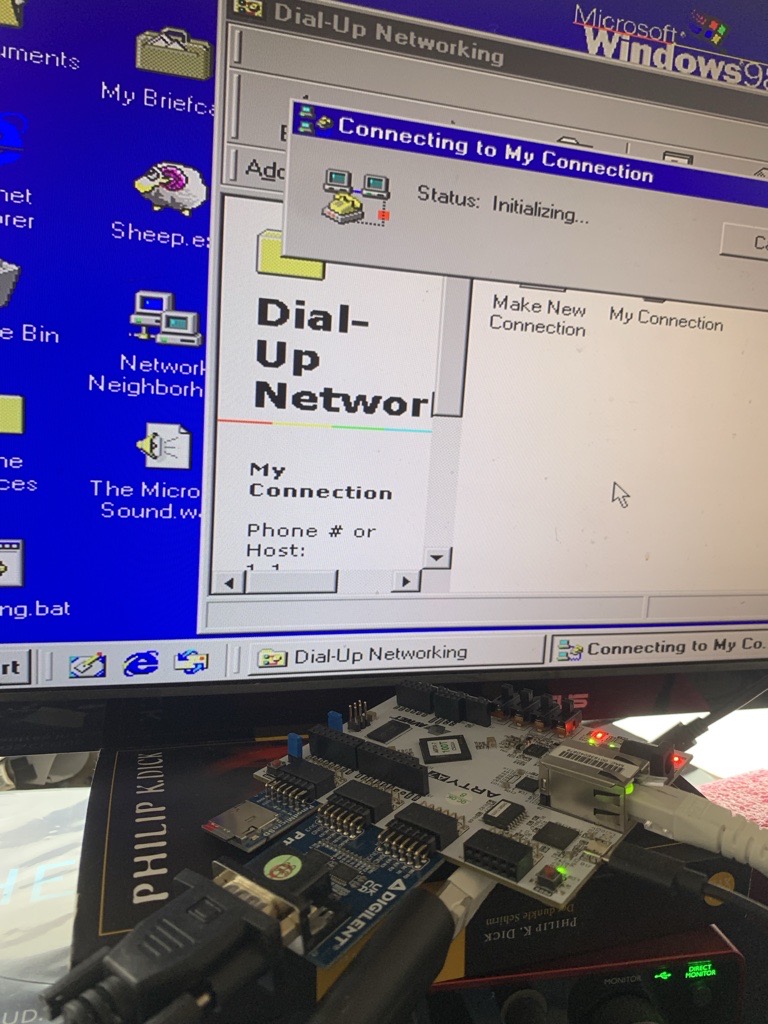
The modem, the PPP peer and the network behind it run on your PC, in user space (libslirp: no root rights). To end, use Start, Shut Down and wait for the message below before you switch off or reprogram the board -- Windows hangs the modem up on its own.
NOTE -- THE WINDOWS 98 IMAGE IS PATCHED ON YOUR MACHINE. The disk image is copy.sh's (the image of copy.sh's v86 demo), with its SeaBIOS and VGA BIOS. The archive normally carries the three in
images/, as downloaded; only when one is missing (as in a git checkout) is it downloaded from copy.sh -- or, when copy.sh fails, from the same files at l8hdl.de, l8hdl.com, l8hdl.se in that order (images/win98/,images/bios/;MIRRORS="…"sets another list). All three are checked by sha256, whichever source they came from. Then a copy of the disk image is modified on this machine: this archive's "no wizard" patch (6 910 sectors) installs the driver for the system's PCI VGA, so Windows 98 starts without the Add New Hardware Wizard. A second patch (5 255 sectors) on top of that copy adds a serial port COM2, the "Standard 33600 bps Modem" on it, a Dial-Up Networking connection "My Connection" and Internet Explorer's start page set to http://l8hdl.se. The original stays as it was,images/windows98.img; the patched copies areimages/windows98_vga.imgandimages/windows98_net.img(the one the board and the Verilator run use).
make check says
what to plug in and which command to run. For Windows 98 a Digilent Pmod
MicroSD on JD with a microSD card (the image is written
to it) — or none (SD=no): then the disk is the image file
on this machine, served to the board over ethernet (KEEP=1
keeps what Windows writes for the next run; without it every boot starts
from the image as downloaded). A Pmod VGA on JB/JC is optional — the
screen is shown on this machine in any case.python3 and the C /
C++ toolchain (Debian's build-essential: cc,
c++, make, the C library's headers -- the
console's screen, the OCR and the host halves are built on first use);
for Windows 98 also curl (or wget) and
mtools; for the Verilator target verilator
(5.0 or newer). make checks and prints one
sudo apt install … line for Debian / Ubuntu; on another
distribution install the same programs by its own means. The programmer
(openFPGALoader) comes with the archive, and its source too, should the
binary not run here.Two networks are involved: the cable between your PC and the board, and -- only for Windows 98's internet -- the dial-up line inside the board's COM2.
| network | who | address |
|---|---|---|
| the Ethernet cable (192.168.77.0/24) | your PC's USB-Ethernet adapter | 192.168.77.1/24 (set by you) |
| the Arty board | 192.168.77.2, MAC 02:00:4c:38:00:01 (both fixed in the bitstream; the MAC on the board's sticker is not used) | |
| the dial-up (PPP over COM2, slirp on your PC; 10.0.2.0/24) | Windows 98 | 10.0.2.15 (given by the provider when it dials) |
| the gateway (your PC, through slirp) | 10.0.2.2 | |
| the name server (your PC's resolver, through slirp) | 10.0.2.3 |
On Linux, once (the adapter's name from ip link show,
e.g. enx00e04c…):
sudo ip addr add 192.168.77.1/24 dev <name>
sudo ip link set <name> up
make check tests the link and prints these lines if the
address is missing. No routing, NAT or root rights are needed for
Windows 98's internet: slirp runs as your user and opens ordinary
sockets on your PC.
? lists
them: R D E U T P G BPX BPM BPR BL BC STACK, and PCH WT PORT SREG for
what the hardware records -- the pc history, the bus write trace, the
port trace). Ctrl-D again, or X, resumes. U
disassembles with objdump (binutils) when it is installed,
and shows bytes otherwise.The Windows 98 PC has no keyboard, mouse or network connector of its
own on the Arty. Those devices are split in two: the PC
side is ordinary hardware in the FPGA (the 8042 keyboard
controller, the VGA, the 16550 on COM2, the IDE disk), and the
host side runs on your PC and talks to it over the
Ethernet cable through one register block, vga_host at
0xC002_0000 on the board's debugger bus. Under Verilator the same
register block is served by the model on a local TCP socket, so the host
programs are the same for the board and the simulation; only the
transport differs.
 your PC                                the Arty
 console.py (terminal) --+                         +-- VGA planes + palette
 webview.py (browser)  --+  Ethernet               +-- 8042: keys, PS/2 mouse
 dialup.py  (modem)    --+-(UDP link)--> vga_host -+
 blk_system (disk)     --+             0xC002_0000 +-- COM2 queues + modem lines
                                                   +-- blk_proxy (top_hb.bit)
under Verilator: simlink.py, a local TCP socket to the model| part | board side | host side | what it does |
|---|---|---|---|
| Screen | vga_host reads the four VGA planes (512 words a
request) and the palette out of the block RAM in the vertical blank
only, so the picture and the CPU are never disturbed |
tools/console.py (terminal),
tools/webview.py (browser, Ctrl-G), drawn by
cosim/vga/vga_screen.h through
vga_ffi.cpp |
text mode as text, mode 13h / mode X and the 640x480 16-colour desktop as pixels; about 0.9 frames a second |
| Text on the screen | -- | cosim/vga/ocr/ (vga_ocr.h) |
reads the text of a graphics screen back by matching the Windows bitmap font pixel for pixel (Ctrl-O): menus, dialogs, icon labels |
| Keyboard | a write to SCAN pushes a byte into the stream the 8042
takes, as if from a PS/2 keyboard |
console.py from the terminal's keys; webview.py from the browser's
KeyboardEvent.code |
set-1 scan codes, press and release |
| Mouse | a write to MOUSE pushes a byte into the 8042's
auxiliary stream |
console.py from the terminal's mouse reports (xterm SGR); webview.py from the browser tab (click the picture to capture the pointer, Esc releases it) | 3-byte PS/2 packets |
| Modem / internet | COM2's 16550: its bytes out through a ring, the host's bytes in, the
modem lines (VH_COM2 / VH_C2N /
VH_C2L) |
tools/dialup.py with cosim/eth/:
modem.h (a Hayes modem: AT commands),
ppp_peer.h (the provider's PPP), eth_slirp.h
(libslirp) |
Windows' Standard 33600 bps modem driver talks to it; any number dialed connects; see "Windows 98 and the internet" |
| Disk without an SD Pmod | blk_proxy in place of the SD controller behind the IDE
(top_hb.bit) |
cosim/hostblk/blk_system.cpp through the bridge
(cosim/bridge/) |
the sectors come from images/windows98_net.img on your
PC; writes kept in memory (or KEEP=1) |
The C++ host halves are compiled on first use and cached
(cosim/cdll.py for the ones loaded into the Python tools;
cosim/bridge/host.sh for the disk): a C++ compiler is all
they need, and the dial-up provider libslirp
(libslirp-dev). The same headers serve the Verilator
testbench directly: vga_door.h reads the model's planes,
and vga_host_door.h answers the board's register block from
the model, so console.py and webview.py attach
to a simulated PC exactly as to the board.
make TARGET=arty CPU=serv          # or CPU=m3
make TARGET=verilator CPU=serv     # or CPU=m3
Both run the same application, the DSP ring: four FreeRTOS tasks pass packets round a ring -- a generator makes two tones, one station transforms them (a 64-point FFT), one filters the higher tone away, one transforms back, and the generator checks that the lower tone alone came back. Equal-priority stations share the processor by time slicing, the generator preempts them, semaphores and a mutex hold it together. It never stops: every packet prints a line at once,
dsp ring on freertos
packet 0 ok     sum 1b743c3c  ok 1 wrong 0  tick 107
packet 1 ok     sum be4b396a  ok 2 wrong 0  tick 173
...
stations' background work: fft 1494 filter 4598 ifft 0
-- the packet's number and verdict, a checksum of the samples that came back (it repeats every eight packets: the amplitude is the packet number's low three bits, so a checksum out of that cycle is a wrong sample), the running counts and the FreeRTOS tick (100 a second on the board). Every sixteen packets a line says how much background work the stations did between packets. Both systems print the same checksums.
/dev/ttyUSB1, or TTY=/dev/ttyUSBn; your
user must be allowed to open it, usually the dialout
group). The console is already listening while the board is programmed.
Ctrl-] leaves; the board keeps running
(python3 tools/serial_console.py /dev/ttyUSB1 attaches
again). Both cores run at 25 MHz. Measured on the board (2026-10-10):
the Cortex-M3 prints a packet every 3 ticks (some 33 lines a second),
serv (bit-serial) one every ~65 ticks (about 1.5 lines a second); both
print the checksums the Verilator runs print.LIMIT=clocks ends a run.systems/serv/dspring_forever.bin and
systems/m3/dspring_forever.bin are the programs the RAM
holds.All numbers below were measured, on the Arty A7-100T or under Verilator on the build host (20 cores), unless marked as derived. The Arty's memory controller runs at 81.25 MHz; the processors run in their own clock domain, a divided copy of it, so the clock of each system is what its timing closure allowed.
| system | processor clock | instruction throughput | on the board |
|---|---|---|---|
| x86, Windows 98 | 20.3 MHz (81.25 / 4) | ~5.25 clocks an instruction on kernel / VMM code, so ~3.9 M instructions a second (derived) -- about a 386 at 25 MHz | desktop 148 s from the boot's start (SD card) (191 s with a screenshot every 20 s); the VGA screen at ~0.9 frames a second in the browser / console view |
| x86, Linux | 16.25 MHz (81.25 / 5) | the same core: ~5.25 clocks an instruction, ~3.1 M instructions a second (derived) | root prompt 63 s after run-linux |
| SPARC V8, Linux | 81.25 MHz | MMU under the caches, 39.68 BogoMIPS | login prompt 17 s after run-linux, the image upload
included |
| ARM (A32), Linux | 16.25 MHz (81.25 / 5) | 2.00 BogoMIPS (timer-based delay loop: says nothing about the core) | shell after 48 s of kernel time, 2 min 14 s wall clock (80 s of it the 17 MB image upload) |
| Cortex-M3, FreeRTOS | 25 MHz | -- | the DSP ring: a packet every 30 ms (3 ticks of 10 ms), no wrong packet in 2000+ |
| serv (RISC-V), FreeRTOS | 25 MHz | bit-serial: some tens of clocks an instruction | the DSP ring: a packet every ~0.65 s (~65 ticks), first after 1.07 s |
Where the x86's clocks go. The microcoded core was
measured on the Linux kernel's boot (3.8 M instructions, the front end's
state recorded each clock): 15.8 clocks an instruction at the start,
then 8.5 (the fetch window kept across instructions), 6.0 (the decoder
runs one instruction ahead), 5.25 (the decoder answers from a partial
window). What remains is mostly the microcode routine itself:
mov r, [m] is three micro-operations, push /
pop three, call five. Hot loops of simple
instructions do better -- the simulation's micro-benchmark (clocks an
instruction, caches warm):
| instruction | clocks |
|---|---|
mov r, r / test |
1.25 (1.0 in a run) |
mov r, [m] |
3.7 |
jz taken |
2.25 |
call + ret (the pair) |
23 |
div (32-bit) |
50 |
rep movsd, a dword |
6.8 |
Windows 98's boot, improvement by improvement (desktop time on the board): 1320 s on the first working core, 810 s after the fetch / decode / cache work, 840 s with the SD card on its native 4-bit bus (the disk was no longer the limit: busy ~11 s of the boot), 191 s and finally 148 s with the processor at 20.3 MHz and the branch work (no hardware wizard any more). A profile of the 148 s boot is flat: the VMM and its drivers take 56 %, there is no idle loop to remove.
The screen. The VGA frame is read out of the board over Ethernet plane by plane and redrawn on the host: about 0.9 frames a second. Enough to work with the mouse and the keyboard, not for video.
Under Verilator (the emitted Verilog, this host):
| model | clocks a second | boot |
|---|---|---|
| x86 Windows 98 | ~42 000 | ~3·10^9 clocks to the desktop: on the order of 20 hours |
| x86 Linux | -- | 257.0 M clocks to the ~ # prompt, 98 min |
| SPARC Linux | -- | 289.5 M clocks, 37 min |
| ARM Linux | -- | 411.8 M clocks, 41 min |
| Cortex-M3 FreeRTOS | ~600 000 | a ring packet about every 1.2 s |
| serv FreeRTOS | ~3 000 000 | first packet after ~9 s, then one every ~5 s |
Every core was built against a working reference -- a "golden sample" that runs the same binary -- and a mismatch against it is a bug in the core until shown otherwise.
| processor | golden reference | how it is compared |
|---|---|---|
| x86 (microcoded, 486-class) | v86 (copy.sh's JavaScript PC) for Windows 98; qemu-system-i386 for the test programs and Linux; the Intel SDM for the instruction semantics | Windows 98: the same disk images run in v86 (port traces, the
dial-up's host side, what a driver's routine returns); every test
program (pc_check.sh) and the random instruction streams
(torture) also built as a qemu flavour and their result words /
program-counter streams compared; a suspect DLL routine's exact bytes
run on both |
| SPARC V8 | qemu-system-sparc -M leon3_generic | the same PROM + kernel boot there to a root shell; the same test programs' output compared |
| ARM (A32, ARMv8-A AArch32) | qemu-system-arm -M virt -cpu max | test programs whose result words are qemu's; a random instruction stream with registers and flags folded into a trace word after each instruction, qemu's trace beside the core's |
| Cortex-M3 (ARMv7-M) | qemu-system-arm -M mps2-an385 | instruction for instruction: qemu's program-counter stream
(-d exec, one instruction a block) beside the core's, then
all sixteen registers per instruction
(compare_regs.sh) |
| serv (RISC-V RV32I) | olofk/serv (Olof Kindgren's SERV, Verilog) | using it as spec; runs its Zephyr and hello programs |
The rule behind it: when a working reference exists, copy it line by
line first and restructure only once it runs. Debugging a full system
against a reference that agrees instruction by instruction found many of
the bugs in doc/history.md.
| directory | what |
|---|---|
scripts/ |
the questions, the checks, the images, the runs |
systems/ |
per processor: the Arty bitstream and the Linux images (serv, m3:
the bitstream carries the program); win98/: its bitstream,
its boot stub and the "no wizard" patch |
tools/ |
the console, the board's debugger protocol, the card programmer, openFPGALoader |
cosim/ |
the C++ host halves of the co-simulated peripherals (the VGA screen and its OCR, …) |
images/ |
copy.sh's Windows 98 image and its two BIOSes (downloaded on the first run when missing), and the patched copies made here |
doc/ |
the pictures above, this page as a PDF, the x86's history |
doc/history.md is the record of the x86 processor's way
from its first instruction to Windows 98 on the board: every bug that
stood in the way, how it was found and what fixed it -- read the history
(doc/history.md).
What each bitstream holds, from the board tops and SoC files named under each picture. The boxes inside the domain frame run in the processor's clock; the host link, the DDR3 controller and (for Windows 98) the VGA and the SD card controller run in the memory controller's 81.25 MHz.
systems/win98/top_sd.bit)┌───────────────────────────────────────────────────────────────────────────────────┐
│ PC clock domain: 20.3 MHz (81.25 MHz / 4) │
│ │
│ ┌───────────────────────────────┐ ┌────────────────────────────────────────────┐ │
│ │ microcoded x86, 486-class │ │ I/O ports IRQ │ │
│ │ x87: small sequential FPU │ │ 8259 x 2 (master 0x20, slave 0xA0) │ │
│ │ I-cache 8 KB (2 x 256 x 16 B) │ │ 8254 PIT 0x40-0x43, port 0x61 0 │ │
│ │ D-cache 8 KB, write buffer 8 │ │ 8042 kbd/mouse 0x60 / 0x64 1, 12 │ │
│ └───────────────────────────────┘ │ CMOS / RTC 0x70-0x71 8 │ │
│ │ memory │ 16550A COM1 0x3F8 4 │ │
│ v │ 16550A COM2 0x2F8 (the modem) 3 │ │
│ ┌──────────────────────────────┐ │ IDE 0x1F0-0x1F7, 0x3F6 14 │ │
│ │ AHB: pcmap (reset alias, │ │ DMA, floppy stub, port 0x92 A20 │ │
│ │ VGA ROM window, A20) │ │ PCI config 0xCF8: 440FX, PIIX3 ISA, │ │
│ │ -> multilayer -> async fifos │ │ PIIX3 IDE, VGA 1234:1111 (ROM BAR) │ │
│ └──────────────────────────────┘ │ VGA 0x3C0-0x3DA, debug port 0x402 │ │
│ └────────────────────────────────────────────┘ │
└───────────────────────────────────────────────────────────────────────────────────┘
│ async fifos (PC <-> 81.25 MHz)
v
┌───────────────────────────────────────────────────────────────────────────────────┐
│ 81.25 MHz domain │
│ │
│ ┌───────────────────────┐ ┌─────────────────────────┐ ┌───────────────────────┐ │
│ │ DDR3 256 MB (MIG) │ │ VGA: planes 256 KB BRAM │ │ SD host, 4-bit bus │ │
│ │ PC physical 0 = DDR 0 │ │ 640x480, Pmod VGA JB/JC │ │ Pmod MicroSD on JD │ │
│ └───────────────────────┘ │ vga_host 0xC002_0000 │ │ IDE -> blk -> sd_host │ │
│ └─────────────────────────┘ └───────────────────────┘ │
└───────────────────────────────────────────────────────────────────────────────────┘
│
v
┌───────────────────────────────────────────────────────────────────────────────┐
│ Ethernet (DP83848 MII), 192.168.77.2, UDP: │
│ 0x8E92 debugger bus master: DDR at 0x4000_0000, control 0xC000_0000, │
│ sd_prog 0xC001_0000, vga_host 0xC002_0000 (screen, keys, mouse, COM2), │
│ traces 0xC003_0000..0xC005_0000 │
│ 0x8E94 console: COM1 bytes │
└───────────────────────────────────────────────────────────────────────────────┘x86/microcodev0/win98/soc/arty/x86_pc_win98_arty.l8,
win98/soc/x86_pc_win98.l8; top_hb.bit is the
same with the SD host replaced by blk_proxy (the disk on
your PC).
Pipeline of the microcoded x86:
┌───────────────────────────────────────────────────┐  ┌───────────────────────────┐
│ FRONT  fetch window                               │  │ branch prediction (front) │
│   4 words (16 B), kept across instructions,       │  │ bimodal: 512 x 2-bit      │
│   refilled while a routine runs;                  │  │ target buffer: 64         │
│   I-cache 8 KB, streaming read, hit under fill;   │  │ return stack: 16          │
│   fetch TLB; a store into code empties it         │  └───────────────────────────┘
└───────────────────────────────────────────────────┘
    │                                                  ┌─────────────────────────────┐
    v                                                  │ x87 (FPU = 2): a sequential │
┌───────────────────────────────────────────────────┐  │ unit on the M stage's       │
│ D1  pre-decode                                    │  │ port space; busy polled     │
│   prefixes, operand / address sizes, ModRM,       │  └─────────────────────────────┘
│   immediates; the LENGTH in the request's clock;  │
│   direct target (jmp / call rel); interrupt       │  ┌──────────────────────────────┐
│   line and faults sampled                         │  │ measured: 5.25 clocks an     │
└───────────────────────────────────────────────────┘  │ instruction (Linux kernel    │
    │                                                  │ boot); mov r, r: 1.25 (sim.) │
    v                                                  └──────────────────────────────┘
┌───────────────────────────────────────────────────┐
│ D2  decode                                        │
│   decode tree -> MacroOp (entry, registers, imm); │
│   entries: interrupt (inta), #PF, exception,      │
│   TLB-miss walk; decodes AHEAD while a routine    │
│   runs (2-entry queue), taken at the retire       │
└───────────────────────────────────────────────────┘
    │
    v
┌───────────────────────────────────────────────────┐
│ R  microcode ROM                                  │
│   8192 x 69 bit block RAM; sequencer: next,       │
│   jmp, cjp, call/ret (4 deep), loop, map          │
└───────────────────────────────────────────────────┘
    │
    v
┌───────────────────────────────────────────────────┐
│ I  issue                                          │
│   temporaries renamed (8 a routine, 4 frames);    │
│   hazards: pending load, flags / counter,         │
│   list register, CSR                              │
└───────────────────────────────────────────────────┘
    │
    v
┌───────────────────────────────────────────────────┐
│ X  execute                                        │
│   register read, barrel shifter, ALU, ADD3        │
│   (an address in one uop); multiplier (2 ranks),  │
│   divider (a bit a clock); data TLB 16 entries;   │
│   D-cache issue; no forwarding                    │
└───────────────────────────────────────────────────┘
    │
    v
┌───────────────────────────────────────────────────┐
│ M  memory                                         │
│   D-cache 8 KB, write buffer 8; load aligned;     │
│   I/O ports; a missing translation is killed      │
│   here, the epoch flips, the pc decodes again     │
└───────────────────────────────────────────────────┘
    │
    v
┌───────────────────────────────────────────────────┐
│ RETIRE                                            │
│   one-entry commit (RD RS1 RDH PC NPC FLAGS)      │
│   at the routine's last uop; rep strings keep     │
│   the elements done (resume)                      │
└───────────────────────────────────────────────────┘
A macro-instruction is decoded into a microcode routine; its
micro-operations flow R I X M. cpux86.l8 (front, decoder),
cpu.l8 (the micro-op pipe), microcodex86.c
(the ROM).
systems/x86/top.bit)┌────────────────────────────────────────────────────────────────────────────────────┐
│ PC clock domain: 16.25 MHz (81.25 MHz / 5) │
│ │
│ ┌─────────────────────────────────────────────┐ ┌───────────────────────────────┐ │
│ │ microcoded x86 (486-class), no x87 │ │ I/O ports IRQ │ │
│ │ I-cache 8 KB, D-cache 8 KB (2 x 256 x 16 B) │ │ 8259 0x20-0x21 │ │
│ └─────────────────────────────────────────────┘ │ 8254 PIT 0x40-0x43 0 │ │
│ │ memory │ 16550 0x3F8-0x3FF 4 │ │
│ v │ cpuid / rdtsc (dev_ident) │ │
│ ┌─────────────────────────────┐ │ other ports read all ones │ │
│ │ AHB multilayer -> ahb_slave │ └───────────────────────────────┘ │
│ │ -> async fifos │ │
│ └─────────────────────────────┘ │
└────────────────────────────────────────────────────────────────────────────────────┘
│
v
┌───────────────────────┐ ┌──────────────────────────────────────┐
│ DDR3 256 MB (MIG) │ │ Ethernet, 192.168.77.2, UDP: │
│ PC physical 0 = DDR 0 │ │ 0x8E92 debugger: DDR at 0x4000_0000, │
└───────────────────────┘ │ control 0xC000_0000 │
│ 0x8E94 console: the 16550's bytes │
└──────────────────────────────────────┘x86/microcodev0/soc/arty/x86_pc_arty.l8,
soc/x86_pc.l8.
The pipeline is the microcoded core shown under Windows 98, built
without the x87 (FPU = 0) and with its own generics
(soc/x86_pc.l8).
systems/sparc/top.bit)┌──────────────────────────────────────────────────────────────────────────────────────┐
│ one clock domain: 81.25 MHz (the memory controller's) │
│ │
│ ┌─────────────────────────────────────────────────────┐ │
│ │ SPARC V8 integer unit, 7 stages (after LEON3's iu3) │ │
│ │ 8 register windows, multiplier, divider, no FPU │ │
│ │ SRMMU: 16-entry TLB, hardware table walk │ │
│ │ I-cache 8 KB, D-cache 8 KB (2 x 256 x 16 B), VIPT, │ │
│ │ write buffer 8; cacheable: 0x4000_0000 only │ │
│ └─────────────────────────────────────────────────────┘ │
│ │ 128-bit cache port; uncached: AHB multilayer │
│ v │
│ ┌───────────────────────────────────┐ ┌───────────────────────────────────────────┐ │
│ │ DDR3 256 MB (MIG) at 0x4000_0000 │ │ AHB -> APB bridge 0x8000_0000 IRQ │ │
│ │ PROM 16 KB loaded at 0x4000_0000, │ │ APBUART 0x8000_0100 2 │ │
│ │ kernel 0x4000 behind it │ │ IRQMP (to the core's IRL) 0x8000_0200 │ │
│ └───────────────────────────────────┘ │ GPTIMER, 2 timers 0x8000_0300 8, 9 │ │
│ │ plug & play ROM 0x800F_F000 │ │
│ └───────────────────────────────────────────┘ │
└──────────────────────────────────────────────────────────────────────────────────────┘
│
v
┌─────────────────────────────────────────────────────────────────────────┐
│ Ethernet, 192.168.77.2, UDP: │
│ 0x8E92 debugger: DDR at 0x4000_0000, control 0xC000_0000, │
│ sparcv8_dbgif 0xC001_0000 (halt, step, registers, 4 breakpoints) │
│ 0x8E94 console: the APBUART's bytes │
└─────────────────────────────────────────────────────────────────────────┘sparc/sparcv8/soc/arty/sparcv8_linux_arty.l8,
soc/sparcv8_soc_fast.l8,
soc/sparcv8_soc_real.l8.
Pipeline of the SPARC V8:
┌─────────────────────────────────────────────┐  ┌──────────────────────────┐
│ F  fetch                                    │  │ divider: sequential,     │
│   I-cache 8 KB (VIPT), 128-bit line port;   │  │ a bit a clock (~34),     │
│   next pc: trap vector, jump from E, branch │  │ holds the pipe; /0 traps │
│   from D, pc + 4                            │  └──────────────────────────┘
└─────────────────────────────────────────────┘
    │                                            ┌───────────────────────────┐
    v                                            │ SRMMU: last-page register │
┌─────────────────────────────────────────────┐  │ + 16-entry TLB, hardware  │
│ D  decode                                   │  │ table walk on the narrow  │
│   decode tree, register file read;          │  │ AHB port                  │
│   Bicc / call resolved HERE: the delay slot │  └───────────────────────────┘
│   hides it (annul for b,a); windows: save / │
│   restore move CWP, WIM traps               │  ┌──────────────────────┐
└─────────────────────────────────────────────┘  │ any cache miss holds │
    │                                            │ every stage (hold)   │
    v                                            └──────────────────────┘
┌─────────────────────────────────────────────┐
│ A  operands                                 │
│   newest of E / M / X / W or the file;      │
│   load-use: one stall (ldlock)              │
└─────────────────────────────────────────────┘
    │
    v
┌─────────────────────────────────────────────┐
│ E  execute                                  │
│   ALU, shifts, address; jmpl / rett target  │
│   (2 bubbles); D-cache access starts;       │
│   multiplier stage 1                        │
└─────────────────────────────────────────────┘
    │
    v
┌─────────────────────────────────────────────┐
│ M  memory                                   │
│   D-cache answers, load aligned, store out; │
│   multiplier: 4 partial products;           │
│   MMU refusal captured                      │
└─────────────────────────────────────────────┘
    │
    v
┌─────────────────────────────────────────────┐
│ X  exception / commit                       │
│   register file, PSR, %y, WIM, TBR;         │
│   precise traps: epoch flips, %l1 / %l2,    │
│   fetch from TBR                            │
└─────────────────────────────────────────────┘
    │
    v
┌─────────────────────────────────────────────┐
│ W                                           │
│   shadow stage: the last forwarding source  │
└─────────────────────────────────────────────┘
Seven stages after grlib's LEON3 integer unit;
sparc/sparcv8/sparcv8.l8.
systems/arm/top.bit)┌───────────────────────────────────────────────────────────────────────────┐
│ core clock domain: 16.25 MHz (81.25 MHz / 5) │
│ │
│ ┌────────────────────────────────────┐ ┌───────────────────────────────┐ │
│ │ ARMv8-A AArch32 (Cortex-A32 shape) │ │ devices IRQ │ │
│ │ 7 stages F D A E M X W; no VFP │ │ 16550 0x1000_0000 GIC 33 │ │
│ │ ARMv7 MMU, 16-entry TLB │ │ GIC 0x1002_0000 │ │
│ │ I-cache 8 KB, D-cache 8 KB │ │ CPU 0x1002_1000 │ │
│ │ generic timer (CP15 c14) 1 MHz │ │ timers (core) GIC 30, 27 │ │
│ └────────────────────────────────────┘ └───────────────────────────────┘ │
│ │ memory │
│ v │
│ ┌─────────────────────────────┐ │
│ │ AHB multilayer -> ahb_slave │ │
│ │ -> async fifos │ │
│ └─────────────────────────────┘ │
└───────────────────────────────────────────────────────────────────────────┘
│
v
┌────────────────────────────────┐ ┌──────────────────────────────────────┐
│ DDR3 (MIG), physical 0 = DDR 0 │ │ Ethernet, 192.168.77.2, UDP: │
│ stub at 0, Image 0x0020_8000, │ │ 0x8E92 debugger: DDR at 0x4000_0000, │
│ DTB 0x01F0_0000 │ │ control 0xC000_0000, │
└────────────────────────────────┘ │ a32_dbgif 0xC001_0000 │
│ 0x8E94 console: the 16550's bytes │
└──────────────────────────────────────┘arm/cortex-a32-armv8-a/soc/arty/a32_arty.l8,
soc/a32_soc.l8.
Pipeline of the ARM A32:
┌───────────────────────────────────────────────┐  ┌──────────────────────┐
│ F  fetch                                      │  │ divider: sequential, │
│   I-cache 8 KB (VIPT); next pc: resume,       │  │ a bit a clock, holds │
│   redirect from X, bx from E, branch from D   │  │ the pipe; /0 gives 0 │
└───────────────────────────────────────────────┘  └──────────────────────┘
    │
    v                                              ┌───────────────────────┐
┌───────────────────────────────────────────────┐  │ ARMv7 MMU: 16-entry   │
│ D  decode                                     │  │ TLB, hardware walk on │
│   decode tree, 3 read ports; b / bl resolved  │  │ its own port          │
│   HERE (1 bubble, no delay slot);             │  └───────────────────────┘
│   ldm / stm / long multiply re-issue the word │
└───────────────────────────────────────────────┘  ┌──────────────────────┐
    │                                              │ banked r13 / r14 per │
    v                                              │ mode; CPSR / SPSR    │
┌───────────────────────────────────────────────┐  └──────────────────────┘
│ A  operands                                   │
│   newest of E / M / X / W, written-back base, │
│   or the file; r15 reads pc + 8;              │
│   load-use: one stall                         │
└───────────────────────────────────────────────┘
    │
    v
┌───────────────────────────────────────────────┐
│ E  execute                                    │
│   condition check (a failing one becomes a    │
│   nop), shifter, ALU, 32x32 multiply;         │
│   address, D-cache access starts; bx here     │
└───────────────────────────────────────────────┘
    │
    v
┌───────────────────────────────────────────────┐
│ M  memory                                     │
│   D-cache answers; interrupts attach here     │
└───────────────────────────────────────────────┘
    │
    v
┌───────────────────────────────────────────────┐
│ X  exception / commit                         │
│   load aligned; rd + base (2 write ports);    │
│   aborts, swi, undef, irq; a write to r15     │
│   redirects (epoch flips)                     │
└───────────────────────────────────────────────┘
    │
    v
┌───────────────────────────────────────────────┐
│ W                                             │
│   shadow stage: the last forwarding source    │
└───────────────────────────────────────────────┘arm/cortex-a32-armv8-a/armv8a.l8: F and D, then the held
pipe A E M X W.
systems/serv/top.bit)┌─────────────────────────────────────────────────────────────────────────────────────────┐
│ slow domain: 25 MHz (100 MHz / 4) │
│ │
│ ┌────────────────────────────────────────┐ ┌─────────────────────────────────────────┐ │
│ │ serv: RV32I + Zicsr, bit-serial │ │ AHB matrix (via serv_ahb) IRQ │ │
│ │ 32 steps an instruction, a bit a clock │ │ RAM 64 KB 0x0000_0000 (the program) │ │
│ │ machine timer interrupt only │ │ 16550 0x4000_0000 │ │
│ └────────────────────────────────────────┘ │ timer 0x8000_0000 machine timer │ │
│ └─────────────────────────────────────────┘ │
│ │ the 16550's line, 97 656 bit/s │
│ v │
│ ┌───────────────────────────────────────────┐ │
│ │ line_rx / line_tx: the bits back to bytes │ │
│ └───────────────────────────────────────────┘ │
└─────────────────────────────────────────────────────────────────────────────────────────┘
│
v
┌──────────────────────────────────────────────────────┐
│ board UART 115200 8N1 -> the Arty's USB: the console │
│ only the USB cable: the program is the RAM's init │
└──────────────────────────────────────────────────────┘riscv/serv/freertos/arty/serv_arty_dsp.l8,
riscv/serv/freertos/serv_rtos_soc.l8,
riscv/serv/serv.l8.
Pipeline of the serv:
┌───────────────────────────────────────────────────┐  ┌─────────────────────────┐
│ fetch  (1 + bus)                                  │  │ branch / jal / jalr:    │
│   read the word at pc; an interrupt goes to trap  │  │ prep2 (1) + pass2 (32): │
└───────────────────────────────────────────────────┘  │ the target, a 2nd pass  │
    │                                                  └─────────────────────────┘
    v
┌───────────────────────────────────────────────────┐  ┌─────────────────────────┐
│ load  (1)                                         │  │ shift: 1 + shamt clocks │
│   a = rs1 / pc, b = rs2 / imm (LUT register file) │  └─────────────────────────┘
└───────────────────────────────────────────────────┘
    │                                                  ┌───────────────────────┐
    v                                                  │ load / store: one bus │
┌───────────────────────────────────────────────────┐  │ access after pass1    │
│ pass1  (32)                                       │  └───────────────────────┘
│   a and b turn once, LSB first, through the       │
│   one-bit ALU into r; pc + 4 into p4; flags       │  ┌───────────────────┐
└───────────────────────────────────────────────────┘  │ csr (1), trap (1) │
    │                                                  └───────────────────┘
    v
┌───────────────────────────────────────────────────┐
│ wb  (1)                                           │
│   rd <- r / p4 / flag; pc <- p4 or the target     │
└───────────────────────────────────────────────────┘
Not a pipeline: one instruction at a time, a bit a clock -- about 35
clocks for an ALU instruction, 68 for a branch or jump ("some forty" on
average). riscv/serv/serv.l8.
systems/m3/top.bit)┌──────────────────────────────────────────────────────────────────────────────────┐
│ slow domain: 25 MHz (100 MHz / 4) │
│ │
│ ┌─────────────────────────────┐ ┌─────────────────────────────────────────────┐ │
│ │ ARMv7-M, 3 stages (F D X) │ │ AHB multilayer IRQ │ │
│ │ no caches; NVIC (16 lines), │ │ RAM 64 KB 0x0000_0000 (the program) │ │
│ │ SysTick, SCB 0xE000_E000 │ │ 16550 0x4000_0000 ext. 0 │ │
│ └─────────────────────────────┘ │ SysTick: the FreeRTOS tick │ │
│ └─────────────────────────────────────────────┘ │
│ │ the 16550's line, 97 656 bit/s │
│ v │
│ ┌───────────────────────────────────────────┐ │
│ │ line_rx / line_tx: the bits back to bytes │ │
│ └───────────────────────────────────────────┘ │
└──────────────────────────────────────────────────────────────────────────────────┘
│
v
┌──────────────────────────────────────────────────────┐
│ board UART 115200 8N1 -> the Arty's USB: the console │
│ only the USB cable: the program is the RAM's init │
└──────────────────────────────────────────────────────┘arm/cortex-m3-armv7-m/soc/arty/m3_arty_dsp.l8,
soc/m3_rom.l8, soc/m3_soc.l8,
armv7m.l8.
Pipeline of the Cortex-M3:
┌────────────────────────────────────────────────┐  ┌───────────────────────┐
│ F  fetch                                       │  │ exception sequencer:  │
│   32-bit word, no cache; a 32-bit Thumb        │  │ stacks 8 words, reads │
│   instruction across words: one extra clock    │  │ the vector, unstacks  │
└────────────────────────────────────────────────┘  │ on EXC_RETURN         │
    │                                               └───────────────────────┘
    v
┌────────────────────────────────────────────────┐  ┌──────────────────┐
│ D  decode                                      │  │ divider: a bit a │
│   m3_decode; the IT block's state advances     │  │ clock (32 + 1)   │
└────────────────────────────────────────────────┘  └──────────────────┘
    │
    v                                               ┌──────────────────────────┐
┌────────────────────────────────────────────────┐  │ list walker: ldm / stm / │
│ X  execute + memory + write-back               │  │ push / pop, a register   │
│   register read (no forwarding: hazards hold), │  │ an access                │
│   shifter, ALU, multiply;                      │  └──────────────────────────┘
│   a branch resolves here (~2 bubbles);         │
│   an access: three clocks, X waits             │
└────────────────────────────────────────────────┘arm/cortex-m3-armv7-m/armv7m.l8: three stages, one
instruction each; the long parts sit below the pipe.
eiselekd at gmail.com