
redback.fysel.ntnu.no/~pihl/midwest/node2.html, Wayback Machine capture of 1999-05-03. About the rebirth 

The target architecture for multipliers is shown in Fig. 2.
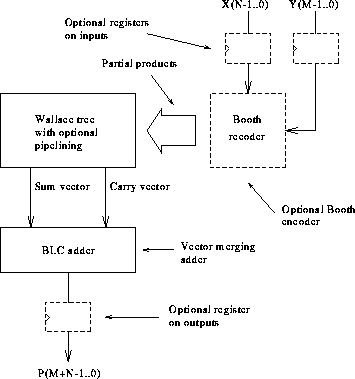
Figure 2: Multiplier target architecture for the module generator.
The module generator's main function is to build the irregular Wallace tree as efficiently as possible from a timing point of view. The generator, written in C, dynamically builds the Wallace trees, trying to reach minimum height of the tallest column [9]. This is accomplished by reducing the number of carries from one column to the next, which generally leads to a shorter and faster Wallace tree. The generator also has rip-up and retry capabilities, and can insert pipelining stages at an arbitrary adder level (Fig. 1).
The module generator produces synthesizable VHDL code, comprising a hierarchical netlist with relatively small behavioral subfunctions in the leaf cells. Typically, the leaf cells comprise full adders, half adders, carry generate and propagate blocks, Booth recoder blocks etc., and each leaf cell has approximately the same complexity as a full adder. Every leaf cell can be implemented with between 1 and 5 gates.