Adder structure
The adder structure is of fast carry lookahead type with a binary tree structure. This means the carries are evaluated in groups of two bits at the first level, in groups of four bits at the second level, third level in groups of 8 bits etc. Finally the sum bits are evaluated using the carries and xor/xnor gates. Because the adder structure is of binary tree type, its inputs and outputs will always have a word length of a power of two (when a width not a power of two is specified, adder width becomes the next higher power of two). The figure below shows an example of an 8-bit binary tree adder.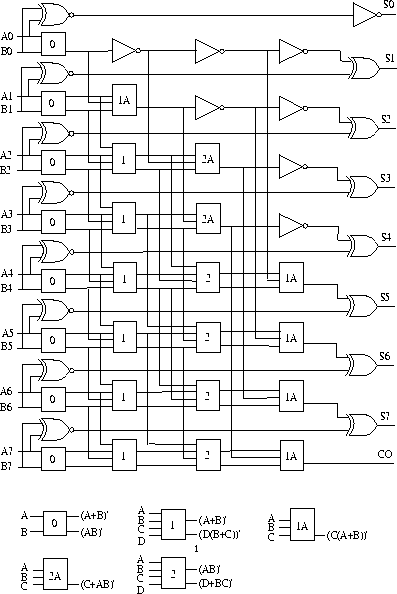
Multiplier target architecture
The multiplier consists of three parts: partial product generator with optional Booth recoding, partial product summation utilizing Wallace trees, and a final vector merging adder of the previously described binary tree type. Registers may also be inserted at the input or output or both, and in one or several pipelining stages internally in the multiplier. The figure below shows an overview of the multiplier target architecture.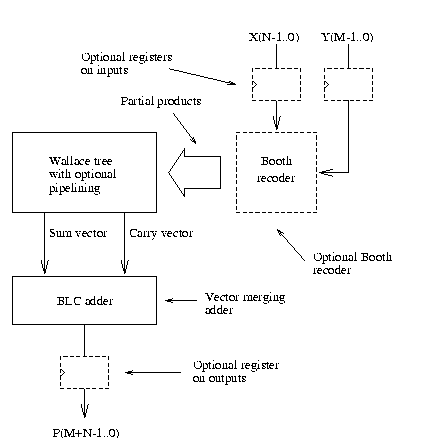
Notice that when Booth recoding is used the number of partial products are reduced to from n to n/2, n being the word length. Booth recoding is a clever way of recoding the original partial products utilizing that multiplication by two is a simple left shift, and that subtraction is simply an inversion. Booth recoding, however, yields more improvement the larger the word length is, such that for multipliers of size approximately 8x8 bit and smaller it is of limited benefit. Also, note that with Booth recoding there will be some potentially large fan-out nodes inside the Booth recoder.
For a squarer the partial product generation exploits the symmetry of the partial product matrix. This is further described in the paper published at 39th Midwest Symposium on Circuits and Systems
Wallace tree structures
Wallace trees and its generalization Dadda's reduction scheme are tree structures for multiple additions. In this context we use the collective term Wallace trees. The figure below shows an example of partial product summation with Wallace trees, for 9-bit operands. CSA=Carry-Save Adder consisting of up to two times the word-length number of full adders.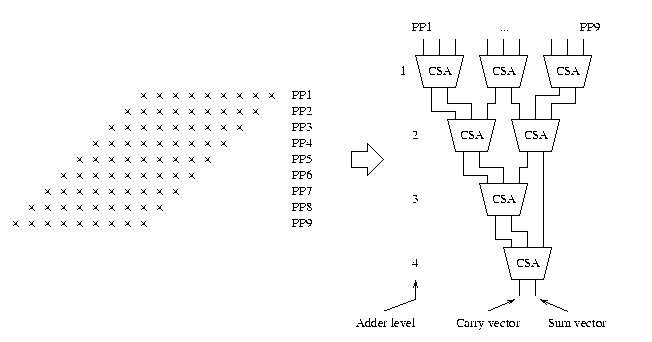
The structure of Wallace trees is not unique, i.e. there are several ways of building a particular Wallace tree. For example, a carry generated in one column may be introduced in the next more significant column at different places, e.g. close to the tree root or close to the output. The Module Generator builds the Wallace trees dynamically with the aim of reducing the number of carries generated in each column, therefore reducing the total tree height. Note that Level in the context of Wallace trees means vertical position within the tree in terms of number of full adder levels.
Buffering and pipelining
Registers may be inserted at the input, output or both, of all generated modules as indicated in the figure on multiplier target architecture above. In addition, flip-flops may be inserted between the full adder levels within the Wallace trees. This is a unique feature for the Module Generator, giving it ability to both build the Wallace trees dynamically and insert arbitrary pipelining. The figure below shows how this is done with the Wallace tree example above, for 1-step pipeline to the left and 2-step pipeline to the right.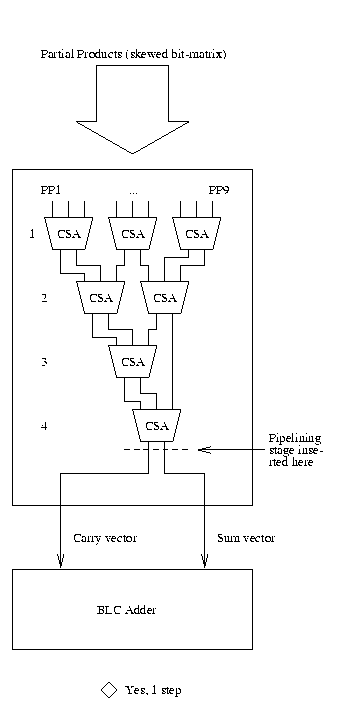
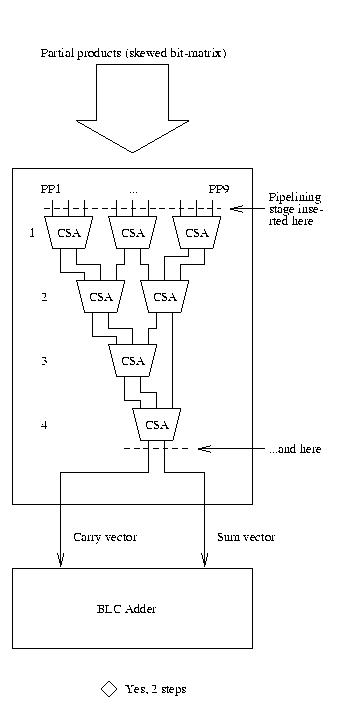
By selecting 'Yes, inside Wallace trees...', the user may explicitly control the insertion of pipelining in the Wallace trees. The pipelining options for pipelining inside the Wallace trees are given as two numbers: (1) the number of full adders between pipelining stages, and (2) the adder level for the first stage. Since the number of adder levels (also called Maxlevel) is determined as Modgen builds the Wallace trees, it is suggested to first make a pre-run of Modgen without pipelining and with 'Verbose' ticked. In Modgen's response there will appear a line stating what Maxlevel is for this particular design. The two numbers for pipelining inside the Wallace trees may then be specified between 1 and Maxlevel.
Notice that the closer the Wallace tree root a pipelining stage is inserted, the higher the number of flip-flops will be. At each full adder level in the Wallace trees the total number of partial product bits are reduced by approximately a factor 3/2, therefore yielding an approximate O(log3/2n) delay behavior.
Options
If you would like to be notified about updates and new features of the module generator, there is also a mailing list:
Add me to the Modgen mailing list.
Johnny Pihl 1998